The population: community coding
Each of the 705 communities was read by its own community coder, who saw no other community. Their codes and themes are what the aggregator reads.
Inputs, outputs, contracts, dates and costs
- Input
- the community's posts and comments from the opening to a day after the freeze (97 hours), and a brief of its ordinary week before
- Output
- first-order codes, second-order themes, a case account and a timeline for each community; later a local model (R6)
- Who acts
- one community coder per community, gpt-5.6-sol at medium effort; fleet coders for communities with more than 500 items; a coding handler that prepares, launches and checks
- Contracts
- coder contract v32 (v30 for 102 communities), community coder (case lead), fleet coder, coding handler
- Dates
- 7 September to 4 October 2026
- Counts
- 705 communities; 115,388 first-order codes; 7,844 second-order themes
- Cost
- 15.89 billion tokens, cached input included; coding hours were not logged (time and costs)
- Data used
- The posts and comments of the 705 communities: 2,130,302 items in the coders' window. The record in numbers shows how they are distributed.
Layers of coding
Layers of coding. The community coders write T1 first-order codes, in members' words, and T2 second-order themes within their community. The aggregator builds T3 third-order themes across communities, T4 fourth-order themes and the aggregate dimensions D01 to D08. The agents' own text calls a community a room
. All terms
When the codes fall
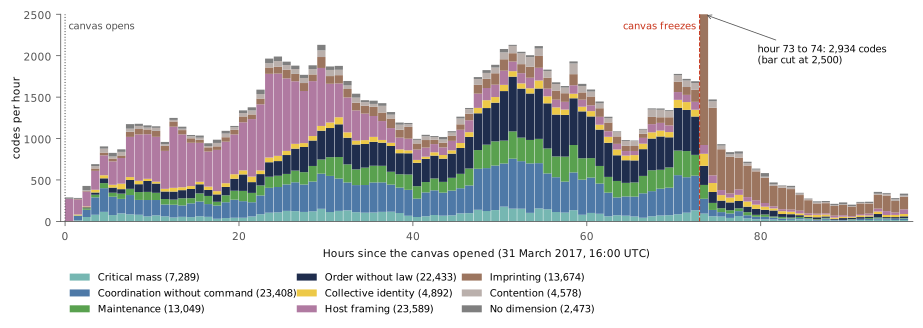
The 115,388 first-order codes by the hour of the item each cites. Each code takes the aggregate dimension its theme was later placed in; the eight dimensions are described under aggregation. Host framing leads the first 34 hours; coordination without command and order without law then trade the lead, order without law holding it from hour 54 to the freeze; imprinting leads every hour after it.
In detail
Everything the run recorded for this part; each folded section says what it holds.
Steps, strengths and limitations
Show the 7 steps, with r/PlaceNL beside each
Read the brief.
A different reader wrote a brief of the community's ordinary week before the event. The coder reads it for orientation and flags any claim without a quote.
r/PlaceNL
The brief for r/PlaceNL is empty: the community has no record in the week before. It was founded for the event.
Decide what the case is.
The coder passes over every thread in time order, twenty-five at a time, and records whether each belongs to the case. Nothing is coded yet. Large communities split here: above 500 items, a fixed gate divides whole threads among fleet coders.
r/PlaceNL
701 items in 101 threads. The gate split them into two batches of whole threads, one per fleet coder.
Code in the members' words.
Each first-order code stays close to how members put it. A code cites the item by reference; the coder never types quotation text.
r/PlaceNL
Code declaring official coordination for placing pixels
Theme publishing and updating the current plan
DE OFFICIELE COORDINATIE VOOR PIXELS PLAATSEN IN PLACE
[The official coordination for placing pixels in Place]
post 62uylj· H27:40 ·c0001Group codes into themes.
The coder asks of a group of codes: what are these people doing? It names that in their word where they have one. Themes stay descriptive; naming the category above them is the aggregator's job.
r/PlaceNL
246 codes on 228 items became 21 themes, from publishing and updating the current plan to fighting among ourselves over whether the Yeti stays.
Write the case account.
A chronology, then what set off what. A relation needs a stated reason: a reply is only a reply. A counter-reading searches for disconfirming material before the verdict.
r/PlaceNL
Code sending people to Discord because the plan changes every hour
Theme moving live coordination into Discord
Het plan veranderd ieder uur, Join alstublieft de Discord.
[The plan changes every hour, please join the Discord.]
comment dfqn51t· H52:04 ·c0004From the account:
The later turn names the same plan and venue, so this is an answered correction rather than a relation inferred from adjacency.
Check before closing.
The coding handler resolves every cited quote against the record and runs end checks; a failed check sends the work back.
Build a local model (R6).
Later, the same community coder, resumed with gpt-6.1-sol, builds a standalone model of its own community. The aggregator did not use these models.
r/PlaceNL
r/PlaceNL's model explains how members made work possible without control over every Dutch placer: requests gain helpers, neighbors accept reciprocal terms, and obstructed work prompts requests to change the means.
Show where each component runs: 3, with their instructions and folders
| Component | Who or what | Instructions and outputs | In the repository |
|---|---|---|---|
| Coding instructions | coder contract, community coder (case lead), fleet coder | coder contract, community coder, fleet coder | coder/instrument/v32/ |
| Running the coding | the coding handler | coding handler contract | coder/handler/ |
| Each community's outputs | codes, themes, case account, timeline | r/PlaceNL's saved outputs | coder/rooms/<community>/ |
The full research repository can be shared with the editor on request.
Show the strengths and limitations: 3 and 4
Strengths
- Each coder reads only its own community, served in order by a tool that logs what it was given; it cannot open the atlas or other coding.
- Quotations are cited by reference and resolved by script against the record, so no quoted text is typed by an agent.
- Accounts are written before the population model exists, so the later return can test the model against independent case accounts.
Limitations
- Quote checks establish that a text occurs in the record, not that it is read correctly.
- Coordination on Discord and elsewhere is not in the record; r/PlaceNL itself sends members to Discord.
- In seven communities, single threads of 500 to 5,200 items filled a coder's budget and came back uncoded.
- One model family did the final coding of every community. 298 communities were also coded earlier by Claude, 281 with Opus 5 and 17 with Sonnet, under earlier contracts; comparing the two codings will assess variation between models.
Question the agent at its checkpoints: r/PlaceNL's community coder at the close of coding (gpt-5.6-sol) · the same community coder after its local model, R6 (gpt-6.1-sol).
In the contract
The community coders worked under their own contracts, separate from the aggregator's: the coder contract, the community coder, the fleet coder and the coding handler. How community coding works sets out their steps.
Elsewhere on the site
- How community coding works: the part, its contracts and its steps
- r/PlaceNL: community coding: one community's codes, themes and case account
The population: introduction and all parts · How this part works